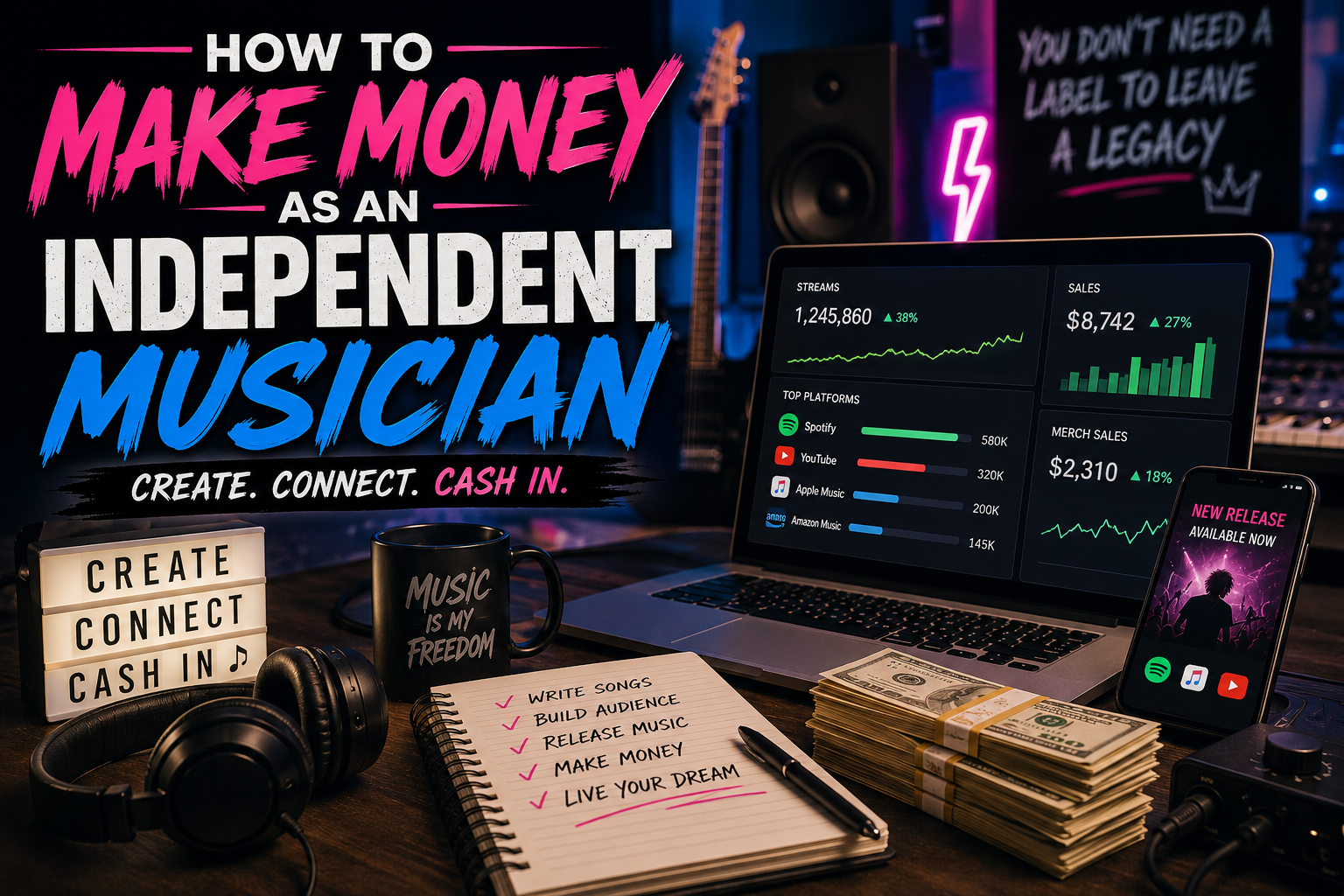

🎸 How to Make Money as an Independent Musician (12 Real Strategies That Work)
Introduction
Being an independent musician has never been more exciting — or more overwhelming.
You’ve got the talent, the drive, and the music. But between streaming payouts that barely cover a coffee, and advice that assumes you already have a massive following, making real money from music can feel impossible.
It’s not.
Thousands of independent musicians are building sustainable incomes without a record label — using a smart mix of income streams that don’t require millions of streams or a viral moment to get going.
In this guide, you’ll discover 12 proven ways to make money as an indie musician, how each one works, and exactly how to start — even if you’re building from zero.
Can You Really Make Money as an Independent Musician?
Yes — but the key is thinking like a music entrepreneur, not just an artist.
The most financially stable independent musicians don’t rely on one income stream. They stack multiple revenue sources so that if one dips, the others hold steady. Think of it like a portfolio: streaming, live gigs, licensing, merch, and fan support all working together.
You don’t need all of them at once. Start with two or three that fit your style and audience — then build from there.
The 12 Best Ways to Make Money as an Independent Musician
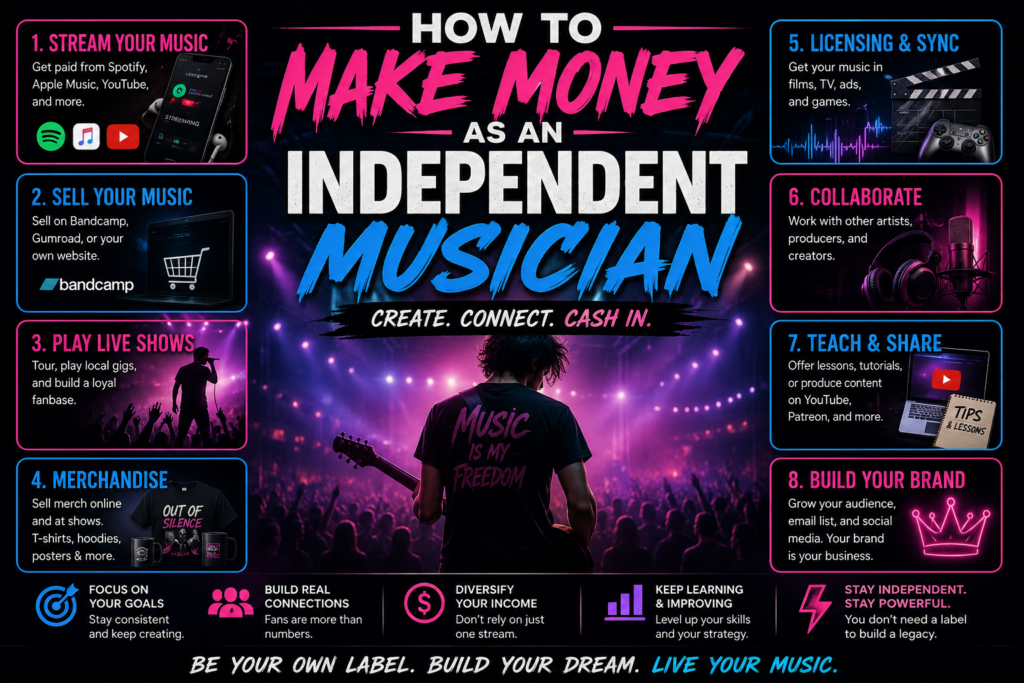
Here’s a quick overview before we dive deep into each one:
| # | Income Stream | Effort to Start | Earning Potential |
|---|---|---|---|
| 1 | Streaming Royalties | Low | Low–Medium |
| 2 | Music Licensing & Sync Deals | Medium | High |
| 3 | Live Performances & Gigs | Medium | Medium–High |
| 4 | Sell Music Directly | Low | Medium |
| 5 | Merchandise | Medium | Medium–High |
| 6 | Patreon & Fan Memberships | Low | Medium (Recurring) |
| 7 | Teaching Music Lessons | Low | Medium–High |
| 8 | Session Work & Collaborations | Medium | Medium–High |
| 9 | Beat Selling & Production | Medium | Medium–High |
| 10 | Brand Deals & Sponsorships | High | High |
| 11 | YouTube & Content Creation | Medium | Medium (Recurring) |
| 12 | Crowdfunding | Low | Medium |
1. Streaming Royalties
Streaming is usually the first thing musicians think about — and the first thing that disappoints them. Spotify pays roughly $0.003–$0.005 per stream, which means you need hundreds of thousands of streams to see meaningful money.
But streaming still matters — here’s why:
- It builds credibility and discoverability
- It generates performance royalties collected by PROs (ASCAP, BMI, SESAC)
- It can be optimized through playlist pitching via Spotify for Artists
How to get started:
Distribute your music through DistroKid, TuneCore, or CD Baby. Register with a PRO to collect royalties you’re likely leaving on the table right now.
2. Music Licensing & Sync Deals
This is one of the highest-earning, most underused income streams for indie musicians. Music licensing means getting your songs placed in TV shows, films, commercials, video games, or YouTube videos — and getting paid every time.
A single sync placement can earn anywhere from $500 to $50,000+, depending on the usage.
How to get started:
- List your music on platforms like Musicbed, Artlist, Pond5, or Songtradr
- Tag your music accurately (mood, tempo, genre) so it’s easy to find
- Pitch directly to indie filmmakers, content creators, and ad agencies
3. Live Performances & Gigs
Live music is still one of the most reliable income streams for independent artists. You don’t need to headline arenas — local venues, private events, weddings, corporate functions, and festivals all pay real money.
| Gig Type | Realistic Earnings |
|---|---|
| Local bar or venue | $100–$500 |
| Private event or wedding | $500–$2,500+ |
| Corporate function | $1,000–$10,000+ |
| Festival or showcase | $500–$5,000+ |
How to get started:
Build a simple press kit (bio, photos, set list, links) and start pitching to local venues. Expand to private events through platforms like GigSalad or The Bash.
4. Sell Your Music Directly
Why give streaming platforms the lion’s share when you can sell directly to fans?
Bandcamp allows fans to buy your music at whatever price they choose — and Bandcamp takes only 10–15%, compared to fractions of a cent from streaming. Fans who buy directly are also your most loyal supporters.
How to get started:
- Set up a Bandcamp page today — it’s free
- Price your albums and EPs fairly ($5–$15 is a common range)
- Offer exclusive bonus content (demos, instrumentals, lyric sheets) to incentivize direct purchases
5. Merchandise
Merch is a powerful income stream because your most loyal fans want to support you tangibly. T-shirts, hoodies, hats, posters, and even digital goods like sample packs or lyric books all count.
How to get started:
Use print-on-demand services like Printful, Printify, or Merchbar so you never have to hold inventory. Sell through your own website or integrate directly with Bandcamp or Shopify.
💡 Pro Tip: Bundle merch with music purchases (e.g., “Album + T-shirt”) to increase your average order value.
6. Patreon & Fan Memberships
Patreon lets your biggest fans pay a monthly amount in exchange for exclusive content — behind-the-scenes videos, early song releases, live Q&As, or private Discord access.
The math is motivating:
100 fans paying $10/month = $1,000/month in recurring income
How to get started:
- Launch a Patreon with 2–3 tiers (e.g., $3 / $10 / $25 per month)
- Keep the lowest tier affordable and offer meaningful value at each level
- Promote it consistently across all your channels
7. Teaching Music Lessons
Your skills are valuable — and people will pay to learn from you. Music lessons (online or in-person) can generate steady, reliable income regardless of where you are in your career.
Realistic hourly rates: $30–$150/hour depending on skill level, genre, and market.
How to get started:
- List yourself on TakeLessons, Lessonface, or Superprof
- Build your own student base through social media and word of mouth
- Create and sell pre-recorded courses through Teachable or Gumroad for passive income
8. Session Work & Collaborations
If you’re a skilled player or vocalist, other artists, producers, and studios will pay for your talent. Session work is consistent, well-paying, and fantastic for building your professional network.
How to get started:
- Build a profile on SoundBetter or AirGigs — platforms where producers hire session musicians remotely
- Reach out directly to local studios, producers, and artists in your genre
- Offer a free or discounted first session to build reviews and credibility
9. Beat Selling & Music Production
If you produce music, selling beats online is a scalable income stream — you create a beat once and can sell it many times over.
How to get started:
- Upload beats to BeatStars or Airbit — the two biggest beat marketplaces
- Offer non-exclusive licenses (lower price, sold many times) and exclusive licenses (higher price, sold once)
- Promote your beats on YouTube, TikTok, and Instagram to drive traffic to your store
10. Brand Deals & Sponsorships
You don’t need millions of followers to land a brand deal. Brands are increasingly working with micro-influencers (1,000–50,000 followers) who have engaged, niche audiences.
As a musician, you’re a natural fit for brands in music gear, lifestyle, tech, and wellness.
How to get started:
- Reach out to brands whose products you already use and genuinely love
- Build a simple media kit (follower stats, audience demographics, engagement rate)
- Join influencer platforms like AspireIQ, Grapevine, or Influencer.co
11. YouTube & Content Creation
YouTube offers ad revenue through its Partner Program, but that’s just the beginning. Your channel can also drive traffic to your merch, Patreon, music sales, and lessons — making it a powerful hub for all your other income streams.
How to get started:
- Post consistently — covers, originals, behind-the-scenes, vlogs, tutorials
- Apply for YouTube monetization once you hit 1,000 subscribers and 4,000 watch hours
- Use your channel to cross-promote every other income stream you have
12. Crowdfunding
Crowdfunding is perfect for funding specific projects — an album recording, a music video, or a tour. Platforms like Kickstarter and Indiegogo let fans pre-fund your work in exchange for rewards.
How to get started:
- Set a clear, achievable funding goal
- Offer creative rewards at different pledge levels (digital download, signed merch, private concert)
- Promote heavily in the weeks leading up to and during your campaign
FAQs: Making Money as an Independent Musician
Q: How much money can an independent musician realistically make?
It varies widely, but indie musicians who stack multiple income streams can realistically earn anywhere from $20,000 to $100,000+ per year. The key is diversification.
Q: Do I need a large following to make money from music?
No. A small but engaged fanbase of even 500–1,000 true fans can generate meaningful income through direct sales, Patreon, and live gigs.
Q: What is the fastest way to start making money as a musician?
Live gigs and teaching music lessons are typically the fastest ways to generate income — you can start booking within days.
Q: Is music licensing hard to get into?
It takes some setup, but once your music is listed on licensing platforms, it can earn passively for years with no additional work.
Conclusion
Making money as an independent musician isn’t about getting lucky — it’s about building multiple, reliable income streams that work together over time.
Start small. Pick two or three strategies from this list that feel natural for where you are right now. Master those, then layer in more as you grow.
The musicians who make it aren’t always the most talented — they’re the ones who treat their music like a business and an art form.
Your music is already valuable. Now it’s time to make sure you’re getting paid for it.
📌 Related Reading:
- How to Get Your Music on Spotify (Step-by-Step)
- How to Build a Music Press Kit That Actually Gets Responses
- Best Platforms to Sell Beats Online in 2024