
How Much Should You Really Charge? A 2026 Rate Calculator
PRICING STRATEGY · FREELANCE RATES · 2026 GUIDE
How Much Should You Really Charge? A 2026 Rate Calculator
Why hourly billing quietly caps your income, the formula for your real minimum rate, and how to package projects and retainers so your pricing reflects your actual value.

Determining your pricing structure as a creative professional, developer, or freelancer in 2026 requires moving far beyond arbitrary guesswork or outdated hourly formulas. As modern markets shift toward value-based deliverables, automated tooling, and specialized project scopes, underpricing your expertise directly limits your business growth and brand authority. At MILEYM3DIA, we understand that establishing profitable, competitive rates is the absolute foundation of building a sustainable, high-income digital enterprise. This comprehensive guide and analytical framework provide the precise blueprint, mathematical models, and strategic methodologies required to calculate your true market value and outprice, outperform, and outlast competing service providers.
The Flaws of Traditional Hourly Pricing in 2026

For decades, the standard approach to freelance compensation relied almost exclusively on the hourly billing model. While straightforward on the surface, this method fundamentally penalizes efficiency, expertise, and technological acceleration. When you leverage advanced workflows, automated software pipelines, and specialized artificial intelligence tools to complete a complex development task or audio production cycle in two hours instead of twenty, charging an hourly rate drastically reduces your total revenue.
Furthermore, clients evaluating services through hourly metrics often focus strictly on cost reduction rather than ultimate business impact. We advise transitioning away from time-based compensation entirely. Modern digital markets reward speed, precision, and measurable return on investment. By anchoring your pricing to the tangible business value you generate for your clients—such as increased conversion rates, streamlined software architecture, or professional brand elevation—you detach your income from the clock and tie it directly to your exceptional skill level.
The Core Components of a Sustainable Rate Formula
Calculating an optimal project or retainer fee demands a rigorous accounting of both personal financial requirements and business operational expenditures. To establish a bulletproof financial baseline, we utilize a multi-variable pricing equation that accounts for your target annual net income, non-billable administrative hours, software subscriptions, hardware depreciation, and tax obligations.
To execute this calculation accurately, aggregate your annual financial targets using the following breakdown:
- Desired Annual Personal Income: The net take-home revenue required to sustain your lifestyle, invest in your future, and achieve financial security.
- Annual Business Overhead: All recurring software licenses, hosting fees, hardware upgrades, legal costs, marketing expenditures, and insurance premiums.
- Estimated Tax Liabilities: The mandatory local, state, and federal tax percentages applicable to independent entities within your jurisdiction.
- Billable Utilization Rate: The realistic percentage of your total working hours spent executing direct client deliverables versus administrative tasks, marketing, and client acquisition. Typically, a 50% to 60% billable ratio represents a sustainable operational ceiling for solo operators and boutique agencies.
By summing your desired personal income, total overhead, and tax obligations, then dividing that aggregate sum by your total annual billable hours, you uncover your absolute minimum viable hourly floor. However, this floor serves merely as a baseline defense mechanism; your actual billing structure must scale upward based on market positioning and value delivery.
Try the Interactive Rate Calculator
Freelance Rate & Income Calculator
Calculate your ideal billable hourly rate based on your goals and overhead.
Your Minimum Recommended Hourly Rate
Formula: (Income + Overhead + Taxes) / Hours
Project-Based Pricing Strategies for Maximum Profitability
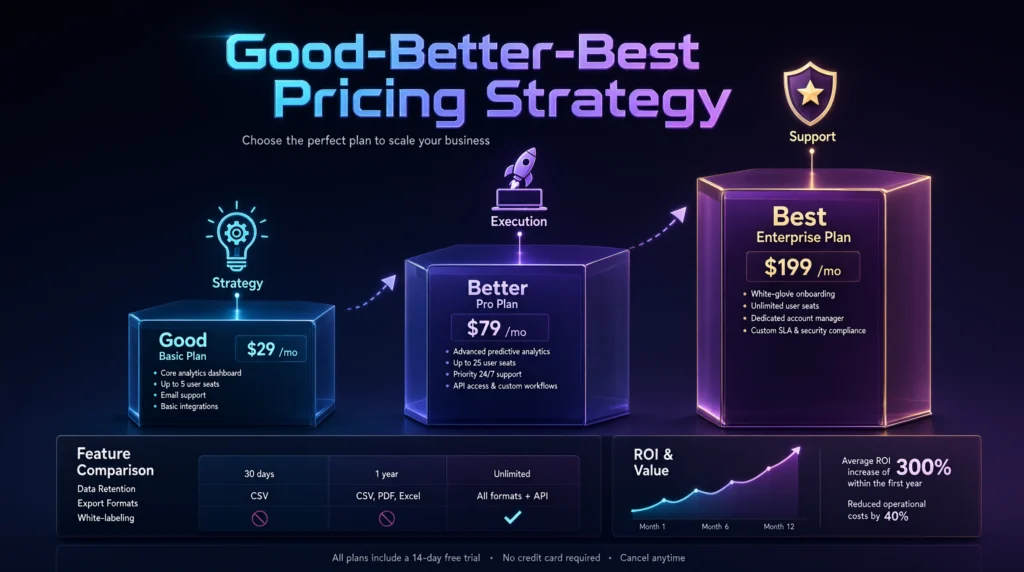
Transitioning to project-based pricing or value-based pricing instantly aligns your incentives with your clients’ primary objectives. Instead of selling units of time, you sell completed transformations, polished digital assets, fully functional web applications, or comprehensive media campaigns.
When scoping a project, we break deliverables down into distinct phases to protect your profit margins and eliminate scope creep:
- Discovery and Strategic Architecture: Deep-dive auditing, wireframing, technical scoping, and asset collection.
- Execution and Development: Core production, coding, design implementation, or audio engineering and mixing.
- Refinement and Quality Assurance: Rigorous testing, client review cycles, cross-platform optimization, and revisions.
- Deployment and Handoff: Final launch execution, documentation, and client training.
Pricing each phase independently or bundling them into an all-inclusive tiered package (such as a Good-Better-Best matrix) empowers clients to select the level of engagement that matches their budget while ensuring you are adequately compensated for every tier of complexity. Premium tiers should always include priority turnaround times, advanced architectural features, and extended post-launch support windows.
Structuring Lucrative Monthly Retainers
Securing recurring revenue through monthly retainers stabilizes your cash flow and safeguards your business against market volatility. A retainer agreement commits a specific block of your monthly capacity—or a defined set of ongoing deliverables—to a select group of high-value clients.
When structuring retainers, we recommend defining strict boundaries regarding rollover hours and scope limitations. Unused hours within a given month should expire automatically to protect your schedule from bottlenecking during peak production cycles. Price your retainers at a slight premium compared to ad-hoc project work, as guaranteed availability and priority queue placement command higher market rates. Offer tiered retainer packages—such as maintenance, growth, and enterprise levels—to accommodate varying client scales without undercutting your time investment.
Psychological Levers and Overcoming Resistance to High Rates
Raising your rates often triggers internal hesitation, but market perception is heavily dictated by pricing psychology. Clients inherently equate low pricing with inferior quality, inexperience, or unreliability. Conversely, premium pricing establishes immediate authority, trust, and professional dominance.
When presenting proposals, we emphasize focusing the conversation exclusively on outcomes, revenue generation, and risk mitigation rather than line-item costs. Frame your pricing as an investment that yields a predictable return. If a custom web application or brand overhaul positions a client to capture an additional ten thousand dollars in monthly sales, a multi-thousand-dollar investment in your expertise represents an exceptionally high ROI. Stand firm in your pricing structure, eliminate apologetic language from your communications, and let your superior quality, technical mastery, and meticulous attention to detail justify every dollar on the invoice.
CREATE. CAPTURE. ELEVATE.
Explore more creative strategy, production, and digital-branding resources from MILEYM3DIA.